
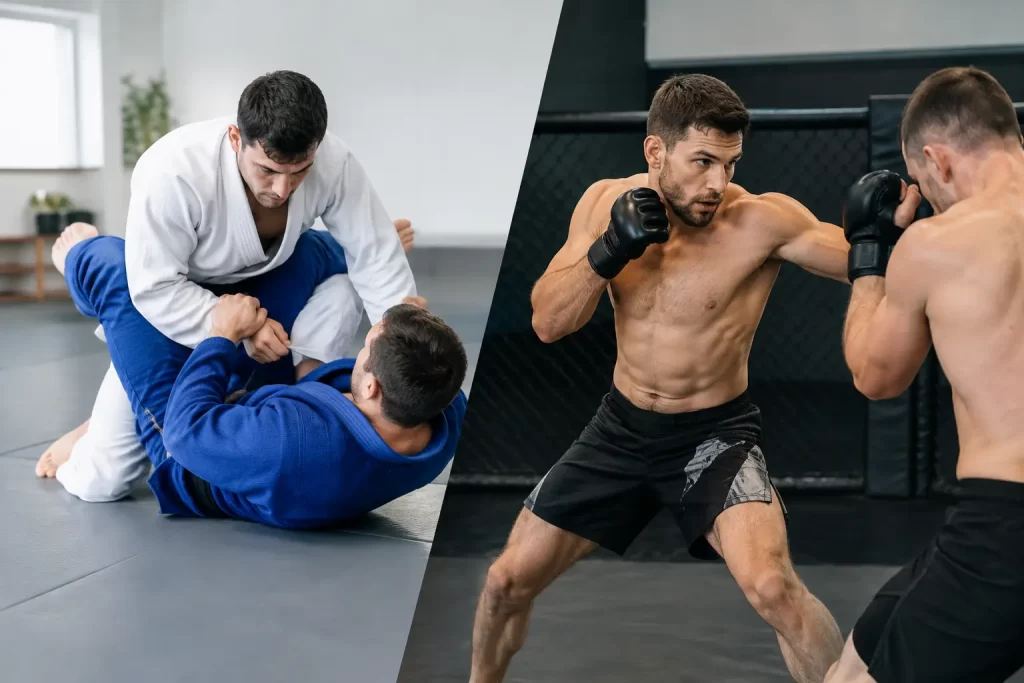
A new student walks into the gym with a clear goal: get stronger, learn self-defense, relieve stress after work, or finally try a combat sport. Then they see Brazilian Jiu-Jitsu classes, boxing, kickboxing, and MMA on the schedule and wonder where to start. The BJJ versus MMA decision is not about choosing the tougher option. Both demand focus, humility, and consistent effort. The better choice is the one that matches what you want from training right now.
For many beginners in North Houston, Brazilian Jiu-Jitsu is the most comfortable first step into martial arts. For others, MMA delivers the variety and full-contact skill set they have been looking for. Understanding the difference helps you walk onto the mats with confidence instead of feeling like you need experience before your first class.
BJJ Versus MMA: The Core Difference
Brazilian Jiu-Jitsu is a grappling martial art. Students learn how to control, escape, submit, and defend against an opponent using leverage, positioning, timing, and technique. Much of the training happens at close range and on the ground. You will practice takedowns, clinch control, guard work, passes, sweeps, escapes, and submissions such as chokes and joint locks.
MMA, or mixed martial arts, combines multiple disciplines into one complete fighting system. It includes grappling, but it also includes striking. An MMA student may train boxing punches, kickboxing kicks and knees, takedowns, cage or wall control, ground-and-pound defense, and Jiu-Jitsu submissions. The goal is to become effective across the full range of a fight.
Put simply, BJJ goes deep into grappling. MMA asks you to connect grappling with striking and transitions. Neither path is automatically better. They solve different training goals.
Why So Many Beginners Start With BJJ
BJJ gives beginners a practical way to learn how to handle physical pressure without needing to trade punches on day one. That matters for adults who want realistic self-defense skills but feel nervous about getting hit, as well as for parents looking for a constructive outlet for their children.
The central lesson of Jiu-Jitsu is that size and strength are not the whole story. A smaller person with strong positioning and patience can manage a larger training partner. That does not mean strength is irrelevant. It means technique gives you options when strength alone is not enough.
BJJ training also develops problem-solving under pressure. You may begin a round pinned underneath someone, low on energy, and uncertain what to do next. With coaching and repetition, you learn to stay calm, protect yourself, create space, and work toward a better position. Those small wins build real confidence that carries into work, school, and everyday life.
For fitness, BJJ is demanding in a way many people do not expect. It strengthens your core, grip, hips, back, and conditioning while keeping your mind engaged. Rather than staring at a treadmill timer, you are focused on the next move. That makes it easier for many students to stay consistent.
What MMA Adds to the Picture
MMA is the right fit for students who want to train a broader combat-sports game. You will learn how distance changes when punches and kicks are involved, how to enter safely for a takedown, and how to use grappling when an opponent is actively striking.
This variety can be exciting. One class may challenge your footwork and boxing combinations. Another may focus on wrestling entries, clinch control, or defending a takedown before working toward a submission. For students who enjoy learning several connected skills, MMA offers a complete and highly athletic training experience.
It also requires more moving parts. A student has to develop awareness at long range, in the pocket, in the clinch, and on the ground. Progress can feel less straightforward at first because there is more to learn. The upside is a well-rounded skill set and a deeper understanding of how different martial arts work together.
MMA does not mean every class is a hard sparring session or that you must plan to compete. Quality instruction builds skills progressively. Beginners learn mechanics, drills, movement, defense, and control before they are asked to apply techniques at higher intensity. Students can train for fitness, self-defense, confidence, and personal challenge without stepping into a cage.
Which Is Better for Self-Defense?
The honest answer is that it depends on the situation and the student. BJJ teaches valuable skills for controlling a person at close range, escaping bad positions, and avoiding panic if a confrontation goes to the ground. Those are major advantages, especially because many real altercations become clinches or grappling exchanges.
MMA adds striking awareness, distance management, and the ability to combine skills. That can make it more complete as a self-defense training format. Still, self-defense is not about winning a fight. It is about recognizing danger early, creating an opportunity to leave, and getting home safely.
For many people, starting with BJJ creates a strong foundation in control and composure. Adding boxing, kickboxing, wrestling, or MMA later can expand that foundation. Someone with a clear interest in striking may prefer to begin with MMA or pair BJJ with a striking class from the start.
The Training Experience Feels Different
In BJJ, live practice usually involves rolling with a partner. You work from different positions and try to improve your control while keeping your partner safe. Since students can tap when caught in a submission, training can be challenging without needing to use unnecessary force. Respect and control are essential.
In MMA, training may include pad work, technical drilling, partner drills, takedown rounds, grappling, and controlled sparring. The pace can feel more varied because you move between striking and grappling ranges. It is an excellent workout, but beginners should expect a learning curve as they become comfortable with stance, movement, timing, and contact.
Safety in both programs comes from good coaching, responsible partners, and training at the right intensity. Hard work is part of martial arts. Getting beaten up is not the goal. A supportive academy should challenge you while making sure you can return, improve, and enjoy the process.
Goals That Point Toward BJJ or MMA
Choose BJJ if you are most interested in grappling, submissions, practical control, stress relief, and building confidence through technical problem-solving. It is also a strong choice if striking feels intimidating right now or if you want a martial art that can become a long-term personal practice.
Choose MMA if you want to learn how punching, kicking, takedowns, and grappling fit together. It may be the better match for students who enjoy variety, want a demanding full-body workout, or hope to compete in amateur MMA someday.
You do not have to lock yourself into one identity. Plenty of athletes train BJJ first, then add striking. Others begin in MMA and discover they love the details of Jiu-Jitsu. Your path can change as your confidence, fitness, and goals grow.
What About Kids and Families?
For children, BJJ is often an excellent starting point because it teaches body awareness, balance, self-control, respect, and confidence in a structured setting. Kids learn to listen, work with partners, manage frustration, and keep trying when a technique does not work immediately. Those lessons matter far beyond the mats.
MMA-style training for young students should always be age-appropriate and carefully supervised. The right focus is skill development, discipline, coordination, and safe contact, not adult-level fighting. Parents should look for instructors who set clear standards, know how to work with children, and create a positive team environment.
Start Where You Can Build Momentum
The best martial art is not the one that sounds most impressive. It is the one you will attend consistently, practice with purpose, and enjoy enough to keep showing up. A welcoming gym can make that decision much easier, especially if you are starting from zero.
At Champions BJJ, beginners train alongside people who remember their own first day. You do not need to be in perfect shape, know the terminology, or arrive with a fighting background. Show up ready to learn, ask questions, and take the first step. A free trial class can help you feel the difference between reading about training and becoming part of the Champions Family.
