
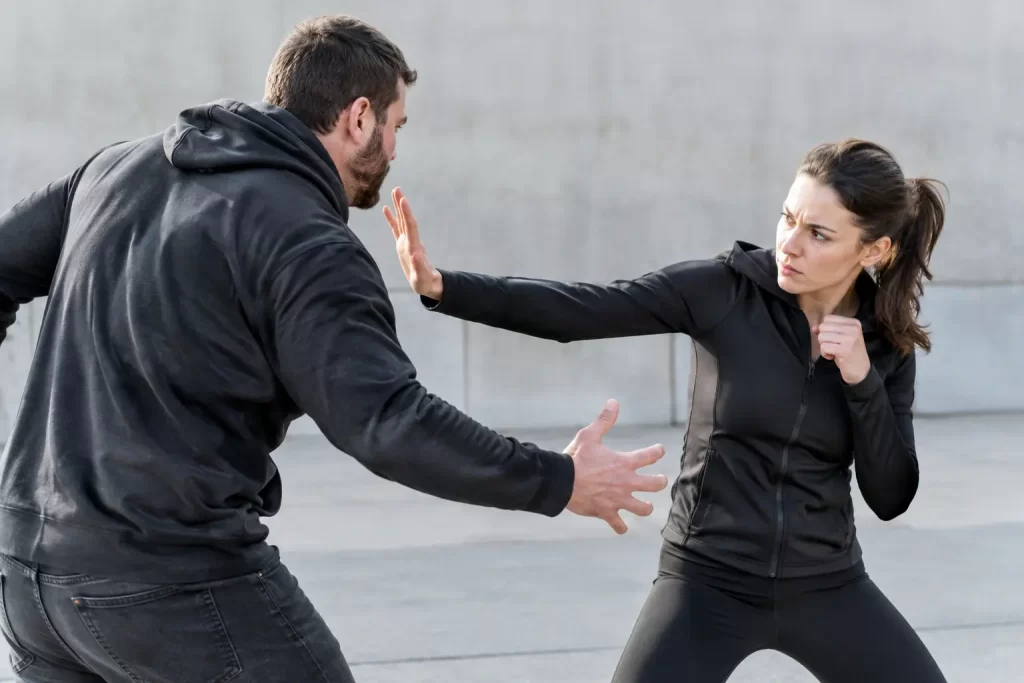
A bigger person can feel impossible to deal with before anything even happens. That fear is real, but self defense against a larger attacker is not about trying to outmuscle someone or prove who is tougher. It is about making smart decisions early, protecting yourself under pressure, creating space, and getting away safely.
Size matters. Strength matters. Anyone who tells you otherwise is selling fantasy. But trained movement, timing, awareness, and calm decision-making can change the situation dramatically. The goal is not to win a fight. The goal is to avoid harm and get home.
Why Size Is Not the Only Factor
A larger attacker may have more reach, body weight, and raw power. That makes trading punches, wrestling for control, or trying to force a takedown a bad plan for most people. The more a situation turns into a strength contest, the more the larger person is likely to benefit.
Good self-defense training shifts the problem. Instead of asking, “How do I beat someone bigger?” ask, “How do I recognize danger sooner, keep distance, break contact, and leave?” Those are skills that can be learned by adults, teens, and kids in age-appropriate ways.
A smaller person also has advantages when they stay mobile and focused. They may be quicker to move, better able to change angles, and less likely to rely on strength when they have trained effective positioning. Brazilian Jiu-Jitsu, boxing, kickboxing, and MMA each develop different parts of that skill set, especially when instruction includes realistic self-defense priorities.
The First Win Is Avoiding the Fight
Self-defense starts well before physical contact. Pay attention when someone is crowding your space, blocking your path, following you, escalating their voice, or ignoring clear boundaries. Trust the feeling that something is off. You do not need to wait for certainty before moving toward a busier, better-lit area or calling for help.
Use your voice early and clearly. A firm “Back up,” “Don’t touch me,” or “I don’t want trouble” can set a boundary while making the situation visible to people nearby. Keep your hands up in a nonthreatening, protective position around chest level, with your palms open if possible. This gives you a natural barrier and puts you in a better position to move or defend yourself.
Distance is your friend. If you can leave, leave. If you can put a car, a counter, a chair, or a group of people between you and the other person, do it. There is no prize for standing your ground when a safe exit is available.
Self Defense Against a Larger Attacker Starts With Position
When someone bigger gets close, standing square in front of them is rarely your best option. A balanced stance, with one foot slightly behind the other, helps you move in any direction without crossing your feet or losing balance. Keep your chin protected, your hands ready, and your eyes up.
The main idea is simple: do not let yourself become easy to grab, drive backward, or pin against a wall. Move at an angle instead of retreating in a straight line whenever space allows. Angle changes can help you avoid their strongest line of force and find an opening to escape.
If contact happens, avoid reaching blindly or trying to shove a much larger person away with both arms. That can pull you off balance and place you within grabbing range. Use your body position, frames with your forearms or hands, and movement to make room. The moment space appears, use it to get away rather than staying engaged.
This is where live training matters. It is easy to understand distance and balance while reading about them. It is harder to apply them when another person is resisting, moving, and creating pressure. Safe, coached practice teaches your body what those moments feel like.
If You Are Taken Down, Focus on Survival and Escape
Many real confrontations end up in a clinch, against a wall, or on the ground. A larger attacker can make those positions especially difficult, which is why a practical program should teach more than striking.
Brazilian Jiu-Jitsu is valuable because it teaches you how to protect yourself when the other person has weight and pressure. You learn how to manage space, avoid panic, protect your head and neck, improve your position, and work toward getting back to your feet. It does not make size disappear, but it gives you options when standing up and walking away is not immediately possible.
The priority on the ground should be to protect yourself, create a path out, stand up when it is safe, and leave. Staying on the ground to control or submit someone may be appropriate in a supervised sport setting, but self-defense is different. Hard surfaces, unknown bystanders, and the possibility of additional threats make escape the smarter objective.
For children, the lesson should be even more direct: use a loud voice, get away, find a trusted adult, and tell them what happened. Kids do not need to carry the burden of handling violence alone. Confidence includes knowing when to get help.
Skills That Make a Real Difference
The most useful self-defense skills are not flashy. They are repeatable under stress and connected to a clear goal: get safe. Four areas deserve consistent practice:
- Awareness and verbal boundaries help you spot trouble early and discourage someone from closing distance.
- Footwork and defensive movement help you stay balanced, manage range, and avoid being trapped.
- Clinch and escape skills help when someone grabs, crowds, or pushes you.
- Ground survival and technical stand-ups help you protect yourself and return to your feet if you fall.
Striking also has a place. Boxing and kickboxing build posture, coordination, distance awareness, and the ability to react when someone is moving toward you aggressively. The purpose is not to look for a knockout. It is to develop confidence with your hands, protect yourself if there is no immediate exit, and create a chance to leave.
Why Pressure Testing Builds Real Confidence
Memorizing a technique is not the same as being able to use it. Stress changes breathing, vision, timing, and judgment. That is why quality martial arts training includes controlled resistance. Partners gradually increase the challenge while instructors keep the environment safe and structured.
A beginner does not need to be thrown into hard sparring on day one. In fact, they should not be. Progress should be built step by step: learning movement, practicing with cooperative partners, then working through realistic pressure at a level that matches experience and goals.
That process replaces panic with familiarity. You learn that a bigger, stronger training partner can apply pressure without breaking your confidence. You learn to breathe, stay present, and keep working for position. Those lessons carry into everyday life, whether you are walking to your car after work, setting boundaries in a tense situation, or simply facing a difficult day with more composure.
Train for Capability, Not Fear
The best self-defense training does not make you paranoid. It makes you more prepared, more aware, and less likely to freeze. It also improves fitness, stress management, discipline, and self-confidence because you are regularly doing hard things in a supportive environment.
At Champions BJJ, beginners train alongside people working toward many different goals, from practical self-defense and weight loss to competition and personal growth. The shared standard is respect: train with purpose, take care of your partners, and keep showing up.
If you are concerned about facing someone larger, do not wait for a frightening moment to find out how you react. Start training in a welcoming environment where you can build skill at your pace. Every class is a chance to become calmer under pressure, stronger in your body, and more confident in your ability to protect your space and get home safely.
