
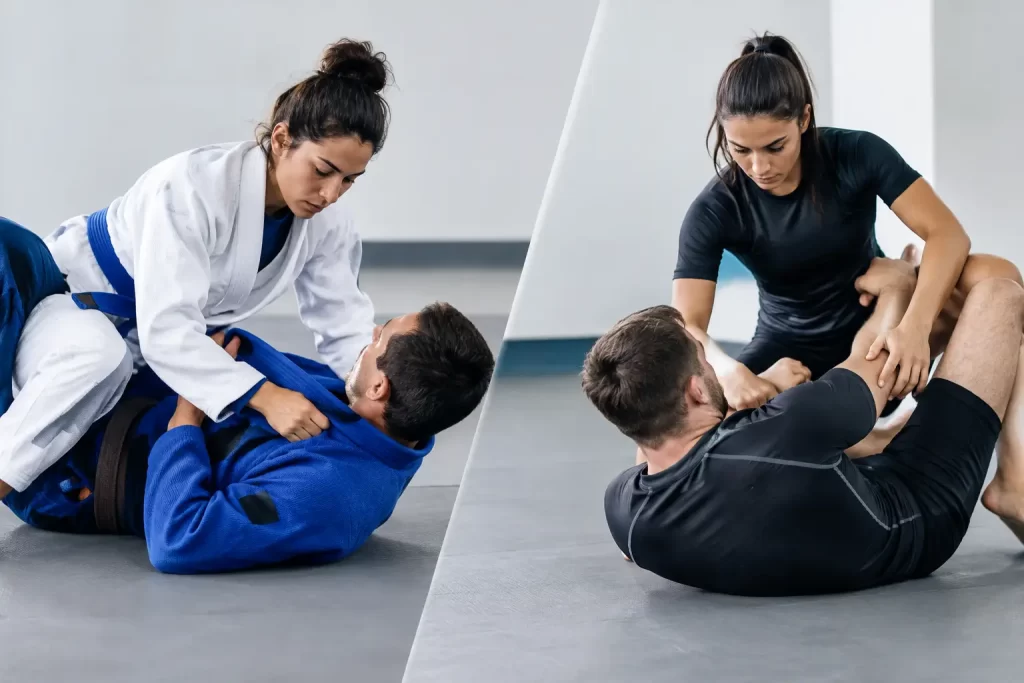
The first time you watch Brazilian Jiu-Jitsu, the question often comes up fast: gi versus no gi – which one should you train? One group is gripping jackets, sleeves, and lapels. The other is moving quickly in shorts and a rash guard. Both are real BJJ. Both can challenge your body, sharpen your focus, and give you a practical skill you can build for years.
The better choice is not about which style is tougher. It is about your goals, your interests, and the kind of training that keeps you showing up consistently. At Champions BJJ, beginners do not need to arrive with a background in wrestling or martial arts. You need a willingness to learn, work hard, and be part of a team that helps you improve.
Gi Versus No Gi: The Main Difference
Gi Jiu-Jitsu is practiced while wearing the traditional BJJ uniform: a durable jacket, pants, and belt. Because your training partner has fabric to grab, the gi adds many gripping options. You can control sleeves, use the collar to create pressure, and use pant grips to slow or redirect movement. This creates a technical game built around posture, balance, timing, and patience.
No gi Jiu-Jitsu is practiced in athletic shorts and a fitted rash guard, without the jacket and pants grips. Since opponents are harder to hold, the pace can feel faster. No gi often places greater emphasis on wrestling-style takedowns, body locks, underhooks, head position, scrambling, and controlling the hips.
Neither style is automatically easier. A gi can be physically demanding because grips can be exhausting and escapes require careful technique. No gi can be demanding because movement is faster and positions can change quickly. In both classes, you will learn how to stay calm under pressure, solve problems when tired, and keep working when the easy answer is gone.
What You Learn in Gi Jiu-Jitsu
Gi training gives beginners a clear introduction to the details of Brazilian Jiu-Jitsu. The uniform creates connection between training partners, which can slow exchanges enough for new students to understand what is happening. You can feel how a grip affects posture, how a small angle changes leverage, and why good position matters before a submission attempt.
The gi also teaches discipline in a very practical way. A careless sleeve or collar grip can put you in trouble. A strong posture, smart hand fighting, and proper frames can keep you safe. Over time, students begin to recognize patterns rather than relying on strength.
Many people enjoy gi training because it is deeply strategic. You may spend several moves building control before finishing a sweep, passing the guard, or setting up a submission. It rewards patience, precision, and consistent repetition. For kids, those lessons can carry well beyond the mats: listen closely, stay composed, and keep working through a challenge.
Gi training can also be a great fit if you want a traditional martial arts experience. The belt system, uniform, and technical depth give students a strong sense of progress. Every class offers a new detail to improve, whether you are attending your first week or have trained for years.
What You Learn in No Gi Jiu-Jitsu
No gi training is direct, athletic, and highly practical. Without cloth grips, you learn to control an opponent through positioning and body connection. Underhooks, wrist control, head position, hip pressure, and takedown entries become especially valuable.
Students who enjoy fast-paced movement often love no gi. The style has a strong connection to wrestling and mixed martial arts, so it can be a natural choice for people interested in MMA competition or adding grappling to their striking training. It is also a great workout. Expect to build conditioning through rounds of drilling, positional sparring, and controlled live training.
No gi teaches an important lesson: when someone is sweaty, moving, and difficult to hold, your technique still has to work. That makes it a valuable training environment for self-defense awareness as well. Still, self-defense is not only about no gi grappling. Real safety depends on awareness, distance, de-escalation, and knowing when to leave. Jiu-Jitsu gives you tools for close-range control if you cannot avoid a physical situation.
Modern no gi competition also includes a wide range of submissions and leg attacks. The exact techniques allowed will depend on the class level, academy rules, and experience of the students. A quality academy teaches these positions responsibly, with clear instruction and a culture where tapping early is respected.
Should Beginners Start With Gi or No Gi?
Beginners can start with either. You do not need to be flexible, athletic, or already in great shape before your first class. Training is how you develop those qualities.
If you like structure, detailed technique, and a slower path to understanding grips and control, the gi may feel like the right starting point. If you are drawn to wrestling, MMA, a faster pace, or athletic scrambling, no gi may immediately click with you.
The strongest answer for many students is to train both when their schedule allows. Gi classes improve your grip fighting, patience, and understanding of leverage. No gi classes develop movement, takedown awareness, and the ability to control without relying on clothing. Skills transfer between the two, even though the strategies are not identical.
Your schedule matters, too. The best program is the one you can attend consistently. Two classes a week over several months will do more for your fitness, confidence, and technique than one intense week followed by a long break. Choose a class time that works around work, school, and family responsibilities, then give yourself time to learn.
What to Wear and Bring
For a gi class, you will need a properly fitted BJJ gi and belt. For no gi, wear a rash guard and athletic shorts without pockets, zippers, or hard objects. For either class, bring water, keep your nails trimmed, and arrive clean with fresh training gear.
These details matter because Jiu-Jitsu is close-contact training. Taking care of your hygiene and equipment is part of taking care of your teammates. That same mutual respect helps create a safer, more welcoming room for beginners, experienced students, parents, and kids alike.
Fitness, Confidence, and Real Progress
People often choose between gi and no gi based on style, but the bigger benefits come from showing up. Both can help you get in better shape, manage stress after a long day, and develop confidence through earned progress. You will learn to breathe when things get uncomfortable, think instead of panic, and trust your ability to improve.
For working adults, that can mean a focused hour away from screens and daily pressure. For parents, it can mean watching a child become more confident, more respectful, and better prepared to handle challenges. For competitors, it can mean building the technical habits and conditioning needed to test themselves at a higher level.
You do not have to decide your entire Jiu-Jitsu future before stepping on the mat. Try a class, ask questions, and pay attention to what makes you want to return. The right choice between gi and no gi is the one that helps you train with purpose, enjoy the process, and keep becoming stronger with your team.
